Anyone can do a yoga class once. The real challenge — and the real benefit — comes from
turning yoga into a practice: something consistent enough that it starts to change how your
body feels and how your mind handles stress. Here’s how to build one that lasts, without
burning out or getting overwhelmed.
Start With Frequency, Not Duration
The most common beginner mistake is trying to do long, intense sessions a few times a
month. Short and frequent beats long and occasional every time, because consistency is
what builds the habit and the physical adaptation.
If you’re just starting out, aim for:
10–15 minutes, 4–5 days a week rather than one 90-minute class on weekends
A fixed time of day if possible — morning to wake up the body, or evening to unwind.
Habits stick better when they’re anchored to a consistent trigger (like “right after I brush
my teeth”).
You can always lengthen sessions later. What matters early on is showing up often enough
that your body and mind start to expect it.
Home Practice vs. Studio Classes
Both have a place, and most people benefit from a mix.
Studio classes give you:
Hands-on corrections from an instructor
Structure and accountability
Community and motivation from practicing alongside others
Home practice gives you:
Flexibility to fit sessions into a busy schedule
No pressure to keep up with a room full of more experienced practitioners
A private space to work on poses you’re still not comfortable with
A good approach for beginners: take 1–2 studio or guided online classes a week to learn
proper form, and fill in the rest of the week with shorter home sessions to reinforce it.
A Simple 15-Minute Daily Routine
You don’t need an elaborate sequence to get real benefit. A simple, repeatable routine
removes the decision fatigue that often kills a new habit.
A basic daily flow:
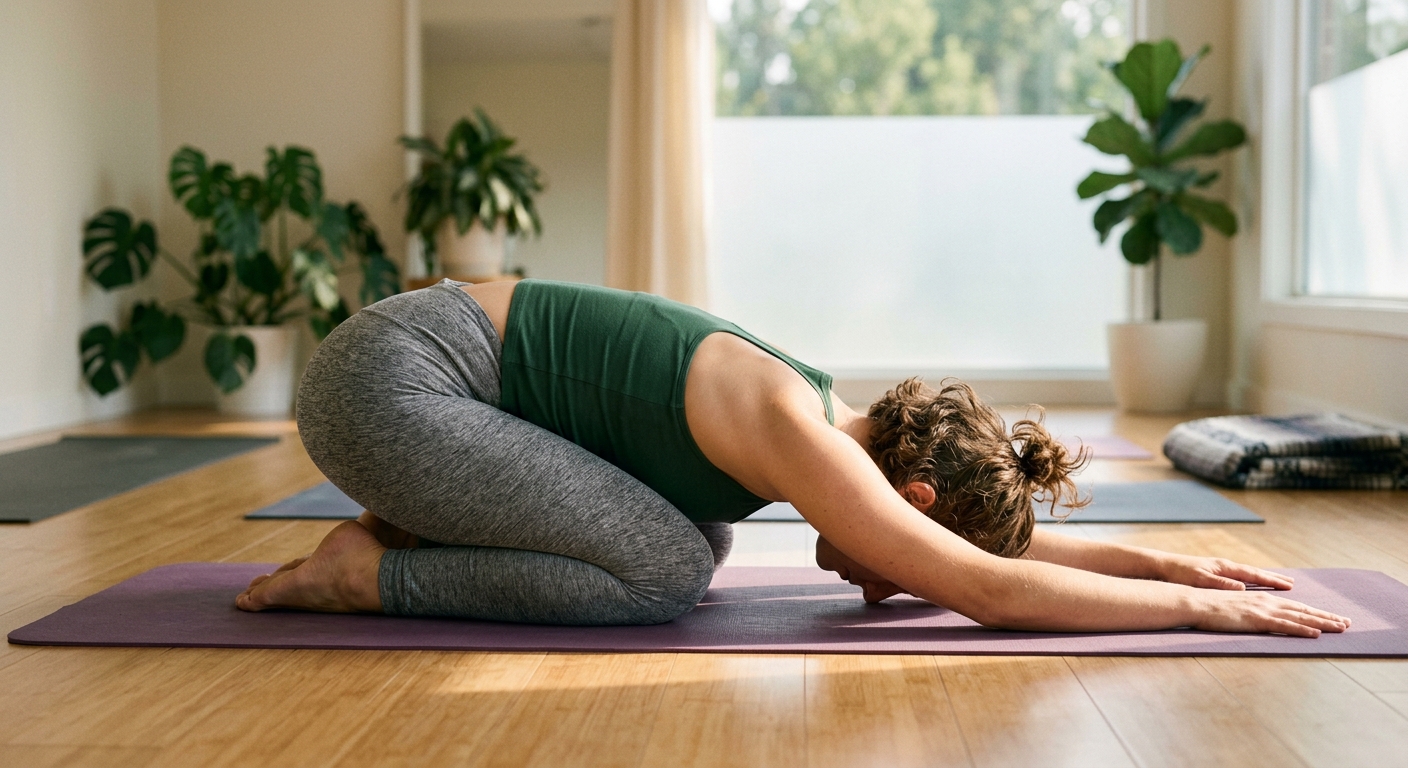
1. Child’s Pose — 1 minute, settle in and breathe
2. Cat-Cow — 8–10 slow rounds, warm up the spine
3. Downward Dog — 1 minute, hold and breathe deeply
4. Sun Salutation A — 3–5 rounds
5. Warrior I and II (each side) — 30 seconds per side
6. Seated Forward Fold — 1–2 minutes
7. Savasana (final rest) — 2–3 minutes
Repeat this same sequence daily for a few weeks. Familiarity lets you focus on breath and
alignment instead of remembering what comes next.
Progressing Safely From Beginner to Intermediate
Once a routine feels easy, it’s tempting to jump straight to advanced poses. Resist that.
Progress in yoga is less about achieving a harder pose and more about deepening
awareness in the poses you already know.
Signs you’re ready to progress:
You can hold foundational poses with steady, relaxed breathing (not held breath or
visible strain)
Your alignment is solid without needing to think about it
You’re curious to explore variations, not just chasing a “harder” version for its own sake
When you do progress, add one new element at a time — a longer hold, a new variation, or a
slightly more advanced pose — rather than overhauling your whole routine at once.
What Consistency Actually Gives You
The physical benefits — flexibility, strength, better posture — show up gradually over weeks
and months. But the bigger shift for most people is mental: a daily practice becomes a
reliable pause button, a few minutes where the rest of the day’s noise quiets down. That’s
the real reason a practice is worth more than the occasional class: it’s not just something
you do, it’s something you build.
What’s stopped you from sticking with a routine in the past? Let me know in the comments
— I’d love to help troubleshoot.

