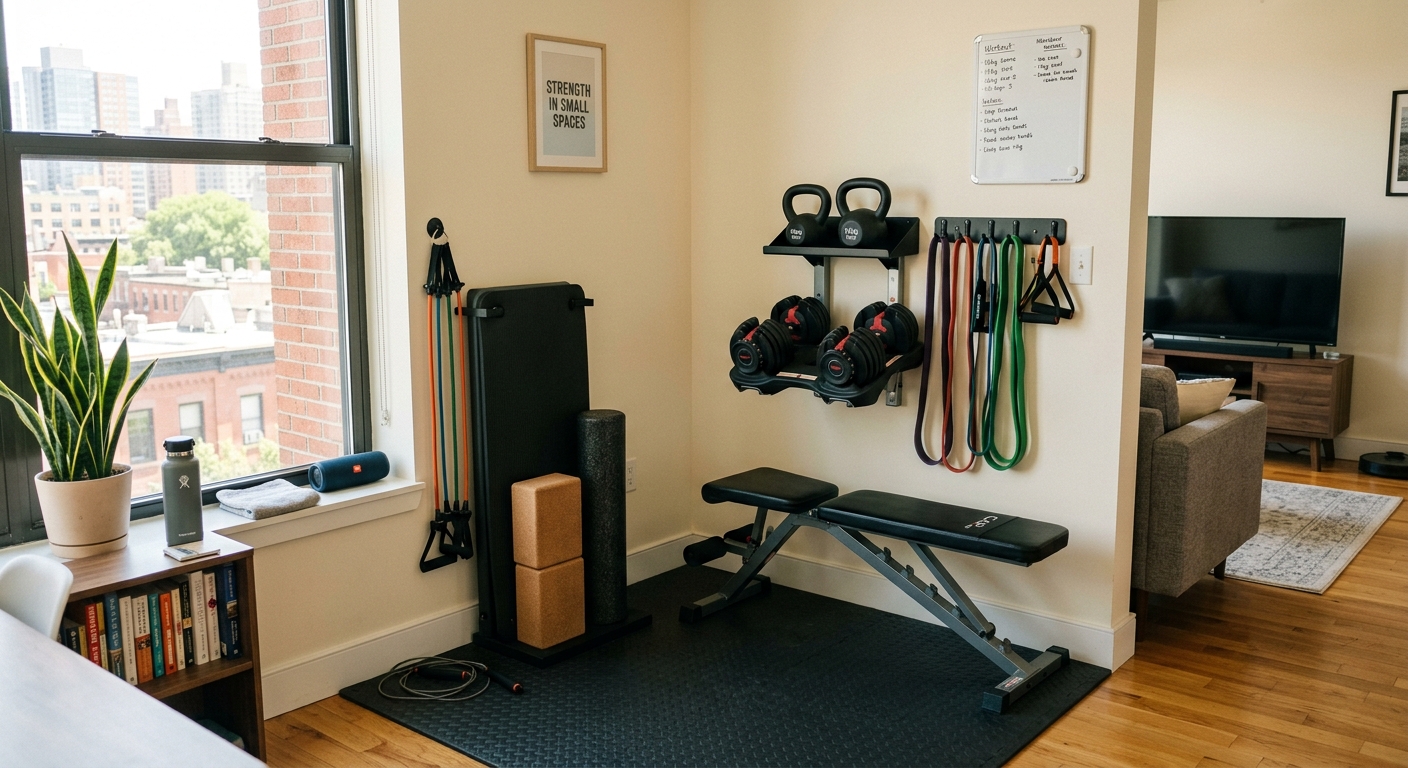
Living in an apartment doesn’t rule out a serious home workout setup — it just means being
smarter about what you buy and how you use your space. No dedicated gym room, no
problem. Here’s how to build an effective training space in a corner, a closet, or even just a
section of your living room.
Think in Terms of “Footprint,” Not “Room”
Instead of asking “where’s my gym going to be,” ask “how much floor space does each
piece of equipment actually need when I’m using it.” Most strength exercises only need
about a 6x6 foot area — roughly the size of a yoga mat with a little room on each side.
Look for:
A corner of a bedroom or living room
Space beside a couch that can be cleared temporarily
A hallway or entryway with a bit of open floor
You’re not carving out permanent gym real estate — you’re identifying a spot that can
become a workout space for 20–30 minutes at a time.
Equipment That Doesn’t Eat Your Space
The key to an apartment-friendly setup is choosing gear that’s compact, stackable, or
foldable.
Adjustable dumbbells — one pair replaces an entire rack of fixed weights, saving
enormous floor space
Resistance bands — take up almost no room and store in a drawer
A foldable exercise mat — rolls or folds away in seconds
A suspension trainer (like a TRX) — anchors to a door and stores in a small bag when
not in use
A doorframe pull-up bar — no permanent mounting needed, removable in seconds
Avoid large machines, benches that don’t fold, and anything requiring a dedicated corner it
can never leave. If it can’t be tucked away, it’s not apartment-friendly.
Vertical Storage Is Your Best Friend
Floor space is precious in an apartment, but wall and vertical space usually isn’t being used
at all.
Mount a small wall rack for resistance bands or a few light dumbbells
Use an over-the-door hook system for bands, jump ropes, or a suspension trainer
Store a folded mat standing upright in a closet corner rather than flat under a bed
Small changes like these mean your equipment stays accessible without permanently
occupying living space.
Workouts That Don’t Require Much Room
Many highly effective workouts need almost no lateral space at all:
Bodyweight circuits — squats, push-ups, lunges, planks all fit in a small footprint
Isometric holds — wall sits, planks, and static holds build strength without any
movement radius
Single-position dumbbell work — presses, curls, and rows can all be done standing in
one spot
A simple structure: 4–5 exercises, 30–40 seconds of work with 15–20 seconds rest,
repeated for 3–4 rounds. This keeps workouts efficient and contained to a small area, with
no need to move around a large room.
Being Considerate of Neighbors
Apartment living adds one more variable most home gym advice ignores: the people below
and beside you.
Choose rubber-coated dumbbells or a thick mat to dampen impact noise
Avoid heavy jumping movements (box jumps, burpees with hard landings) during early
morning or late evening hours
A cushioned exercise mat under any equipment reduces both noise and the risk of floor
damage
A little consideration here goes a long way toward keeping your workout routine — and your
relationship with your neighbors — sustainable long-term.
Small Space Doesn’t Mean Small Results
The perception that a “real” home gym needs a spare room is what stops a lot of apartment
dwellers from starting at all. In reality, a corner, a few pieces of foldable equipment, and a
consistent routine can deliver the same strength and fitness gains as a fully equipped
garage gym. The limiting factor was never square footage — it’s consistency, and that fits in
any apartment.
What’s your biggest space challenge when it comes to working out at home? Let me know
in the comments — I’d love to help you find a solution.

